From Landfill to Legacy:
Dubai’s Smart Waste Revolution
Reshaping Urban Sustainability
Dubai is transforming urban waste management with IoT-enabled bins, AI-powered sorting, and data-driven route optimisation — slashing landfill use, cutting carbon emissions, and pioneering a global model for a circular economy built to last.

Dubai’s smart waste management revolution is reshaping urban sustainability with data-led bins, AI-optimised route planning, and advanced recycling technology designed to slash landfill use and measurably reduce carbon emissions across the emirate.
Smart sensors monitor fill levels in real time, enabling collection crews to schedule fewer trips and conserve fuel across every district. Material recovery facilities (MRFs) sort plastics, metals, and organics at scale, achieving significantly improved diversion yields compared to legacy systems.
Pay-as-you-throw pilots are testing equitable price signals for households and businesses alike. Policy frameworks now connect objectives directly to measurable outcomes — including diversion rates and verified CO₂ reductions — creating a live accountability loop between government ambition and ground-level performance.
The Vision

Dubai frames smart waste management as a cornerstone of a broader plan for a connected, low-carbon city. The goal is unambiguous: design urban systems that cut waste at source, reuse materials within closed-loop supply chains, and run on clean energy. This connects waste policy to land use, transit infrastructure, green finance, and digital platforms — ensuring economic growth stays within ecological limits while supporting a more sustainable UAE economy.
| Dubai’s Sustainability Vision | What It Includes | Why It Matters | Global Alignment |
|---|---|---|---|
| Smart waste systems | IoT bins, analytics, MRFs, composting | Less landfill use, higher material recovery | SDG 11, 12 |
| Circular economy | Reuse, repair, upcycle markets | Keeps materials in use longer | EU CEAP, ISO 59010 |
| Clean energy | Solar-powered plants, EV fleets | Lower emissions per tonne handled | Paris Agreement |
| Green finance | Sustainability-linked loans, PPPs | Scales technology fast and equitably | GFANZ principles |
| Urban planning | Mixed-use zones, green corridors | Shorter hauls, better air quality | C40 clean air goals |
Beyond Landfills
Dubai’s strategy targets a phased phase-down of landfill dependency through new sorting lines, organic waste routed to anaerobic digestion, and waste-to-energy as a last-resort step for non-recyclable residuals. Compost and digestate nourish urban farms and city landscaping, while high-grade plastics, metals, and paper feed back into commercial supply chains. This approach couples processing facilities with rigorous source separation mandates so downstream plants receive cleaner, higher-value material streams.
- Landfill caps set by year, with steadily increasing diversion targets and PAYT tariffs
- Extended producer responsibility (EPR) for packaging, electronics, and bottle deposit-return schemes
- Bans on select single-use materials and unprocessed organic waste disposal
- Real-time truck routing and contamination fines connected to live data dashboards
Green building codes now mandate on-site sorting rooms, modular design, and take-back plans for fixtures and fittings. Concrete and steel reuse standards significantly reduce demolition waste volumes at city scale.
A Circular Economy
Dubai’s circular economy vision supports reuse hubs, repair service networks, and material passports embedded in buildings from construction. It connects logistics parks with premium MRFs to help make secondary materials commercially bankable and investor-grade.
Smart bins equipped with RFID tags and optical identification systems nudge improved sorting behaviours, while rebates on utility bills and tiered fee structures reward households and businesses that consistently hit their targets. Local recyclers and green solution providers receive offtake contracts and preferential power pricing, helping close material loops for glass, aluminium, and PET plastic.
Urban Sustainability
Waste systems in Dubai are embedded within sustainable districts so that streets, parks, and buildings actively integrate collection infrastructure. Shorter collection routes mean fewer trucks, less neighbourhood noise, and cleaner urban air.
- Shaded walkways, native trees, and cool pavements reduce the urban heat island effect
- Mixed-use zoning shortens collection hauls and boosts service density
- Shared loading bays and micro-hubs limit heavy vehicle traffic in residential zones
- Clear signage and mobile apps raise sorting accuracy and community trust
Dubai’s Smart Arsenal
Dubai integrates its waste technology with wider smart city platforms. The same infrastructure powering urban mobility and public safety also drives waste storage, collection scheduling, and treatment logistics — turning the city into a live proof-of-concept for a data-driven, low-emission metropolis. AI, IoT, robotics, and blockchain collaborate across every node to boost service efficiency, reduce carbon output, and track impact in real time.
1. Intelligent Bins
Fill-level sensors, GPS tracking, and tilt alerts schedule pickups before overflow. Solar-powered compression increases bin capacity up to 8×, dramatically reducing collection frequency and associated fuel costs.
2. AI-Powered Sorting
Computer vision and near-infrared scanners at MRFs identify plastics, metals, glass, and organics on high-speed conveyor belts. Models continuously learn from local waste streams, maintaining precision as packaging evolves.
3. IoT Route Optimisation
GPS fleet units and bin sensors supply live volume and location data to a centralised routing engine. Routes are recalculated dynamically, avoiding peak-hour congestion and reducing fuel consumption across the network.
4. Data Analytics
City analysts monitor KPIs by district, building type, and season — tracking diversion rates, missed pickups, fuel per tonne, and complaint response times to guide targeted infrastructure investment.
5. Robotic Automation
Robotic sorting systems boost precision and throughput on MRF lines, separate hazardous materials, and minimise worker contact with dangerous waste — enabling facilities to serve more residents without proportional staff increases.
6. Waste-to-Energy
Non-recyclable residuals feed waste-to-energy facilities that generate clean electricity, with anaerobic digestion capturing methane from organic waste for use in fleet vehicles and district energy systems.
Reshaping The City
Smart waste infrastructure is woven into Dubai’s broader urban planning framework — not treated as a peripheral utility. The city connects bins, trucks, MRFs, and analytics to land use codes, zoning regulations, and municipal services. The objective is clear: less waste sent to landfill, more resources circulated back into the economy, cleaner air, and an urban environment that works for both people and the natural world.
- Map waste flows for each district to align collection routing with land use, transit corridors, and green zones.
- Mandate on-site sorting rooms, food-waste chutes to composters, and accessible e-waste collection points in all new building codes.
- Deploy IoT bins, pneumatic pipe systems in high-density zones, and solar-powered smart transfer hubs.
- Build material recovery capacity: MRFs, anaerobic digesters, compost pads, and community reuse depots.
- Apply price signals: pay-as-you-throw, reduced fees for pre-sorted streams, and compost rebates.
- Publish open data on diversion rates, air quality index (AQI), and water metrics to guide policy and build public confidence.
- Feed outputs back into city systems — compost to parks, recyclate into street furniture, biogas to fleet vehicles.
- Train operations staff, engage communities in behaviour change programmes, and update policy as technology and social norms evolve.
Environmental Impact
Smart routing and pneumatic collection systems measurably reduce truck kilometres and vehicle idling — directly cutting carbon emissions across Dubai’s collection network. Anaerobic digestion of food waste captures methane for clean energy generation, while recycling metals and plastics reduces dependence on carbon-intensive virgin material production.
Landfill diversion also improves local air quality by minimising open-bin odours and dust particulates, and it safeguards groundwater systems from leachate contamination. Enhanced e-waste streams prevent heavy metals from contaminating soil and water tables across the emirate.
Measurable Impact Across Dubai
Economic Shifts
Dubai’s investment in sorting robots, optical scanners, and digesters is actively creating a green economy with skilled employment opportunities. This aligns directly with the UAE’s development philosophy of harmonising environmental health, economic productivity, and quality of life.
Fewer landfill transfers and smarter route design reduce fuel, labour, and tipping costs. Long-term recyclate offtake contracts generate consistent secondary material revenue. Smart city achievements attract international investors and global technology partners, establishing Dubai as a reference standard for cities seeking digital-ecological balance.
The Human Element

Intelligent waste systems only deliver on their promise when people actively engage with them. Success depends on everyday decisions, shared values, and genuine trust between public institutions and private citizens. Environmental quality is inseparable from human health — air and water pollution increase disease burden, which is why initiatives like the International Day of Clean Air for Blue Skies (September 7) motivate cities to pursue measurable emission reductions year-round.
Behavioural Nudges
Mobile push notifications timed to collection schedules reduce missed pickups and deter fly-tipping. Opt-in alerts flag when nearby smart bins approach capacity or when contamination is detected in a sorted stream.
Gamified sorting points, neighbourhood leaderboards, and monthly achievement badges make correct behaviour the default choice. Real-time feedback screens at drop-off points display kilograms diverted, litres of water saved, and estimated CO₂ avoided — making the impact of individual choices tangible and visible.
When residents faced a 9% water use reduction target, one programme saved 8.1 million gallons. This demonstrates how clearly communicated targets, combined with visible impact data, can drive extraordinary collective outcomes — the same principle applies directly to waste sorting compliance.
Public-Private Synergy
Dubai Municipality sets regulatory frameworks and diversion targets while private operators and technology companies deliver route AI, fill-level sensor networks, and material recovery services. Both roles are essential and mutually reinforcing.
Pilot projects de-risk innovation before citywide rollout. A partnership might trial composting infrastructure for food court clusters, or RFID-labelled bins across mixed-use residential blocks. What performs in pilots scales across districts, then citywide. Shared performance dashboards accelerate learning and create accountability: waste haulers track collection times and contamination rates; tech companies share sorter precision data; the municipality measures emissions and diversion outcomes. Linking financial incentives — including performance fees — to purity rates and public health outcomes keeps commercial interests fully aligned with societal goals.
Educational Outreach
Schools operate maker labs that transform plastic waste into construction bricks, run composting pilot programmes, and calculate methane emissions avoided per tonne of food waste diverted. Students develop hands-on understanding of circular material flows, soil science, and the direct link between clean air and community wellbeing.
Digital guides, in-app tutorials, and community-centre demonstrations reach renters, service workers, and newly arrived residents. Onboarding videos help new building occupants adopt correct sorting habits rapidly. NGO partnerships bring grassroots credibility and deep community access to behaviour change initiatives.
Global Blueprint
Dubai offers a replicable framework for sustainable urban waste management that cities across the world can adapt and scale. Shared standards, open data architecture, and publicly verified outcome data enable cities to align on climate and waste reduction commitments while respecting local regulatory and cultural contexts.
| Area | Dubai’s Practice | Notable Practices Elsewhere | Policy Notes |
|---|---|---|---|
| Collection | IoT bins, route optimisation, solar compactors | Seoul RFID pay-as-you-throw; Barcelona sensor bins | Data-sharing MoUs with operators |
| Sorting | MRFs with optical sorters, AI vision | Singapore high-efficiency sorting hubs | Producer responsibility pilots |
| Organics | Aerobic digestion, biofertiliser pilots | Milan citywide source separation | Food waste mandates by sector |
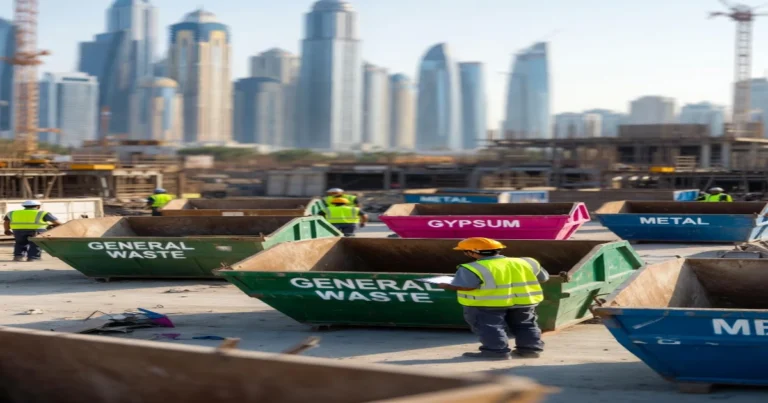
| Construction waste | Fakhruddin “90:90” Initiative — 90% diversion target | Tokyo C&D recycling ordinances | Contractor diversion targets in permits |
| Governance | KPI dashboards, public performance reporting | Copenhagen climate budgets | Results-linked contracts |
| Engagement | Multilingual apps, nudges, utility bill rewards | Taipei smart card incentives | Clear privacy and data ethics standards |
A Replicable Model
The Dubai smart waste framework is standardised around four foundational blocks: sensing and data (bin sensors, fleet telematics), processing (MRFs, organics treatment), policy (pricing signals, EPR mandates), and people (behaviour design and community outreach). Minimum technical specifications and open API interfaces keep vendor lock-in low and integration costs manageable.
Track the KPIs that matter most to budgets and public health outcomes: kg waste per capita, diversion rate, route kilometres per tonne, contamination rate, worker injury rate, complaint response time, methane reduction volume, and net cost per tonne handled. Quarterly public dashboards sustain institutional accountability across electoral cycles.
Overcoming Hurdles
Smart waste systems deliver leaner operations and cleaner air — but encounter real-world friction in any fast-growing city. Dubai’s ambition sits within broader targets: zero waste by 2050, cleaner air tied to UAE Vision 2021, and deep reductions in carbon emissions. High upfront capital costs remain the primary barrier to rollout. Smart bins, route sensors, AI sorting lines, and waste-to-energy plants all require significant investment and extended payback horizons.
Cooling loads — representing over 70% of GCC peak electricity demand — interact with waste scheme scheduling. Locating transfer hubs near district cooling plants enables data sharing and reduces truck idling, benefiting both air quality and fuel budgets. A phased deployment strategy proves most effective: begin with route sensors in dense districts, add smart bins at high-traffic nodes, and introduce AI sorting infrastructure only after baseline data validates the business case.
Public buy-in requires sustained effort. Sorting at home and at work is the operational foundation of the entire system, but habits shift gradually. Obvious labelling, building-level diversion feedback, and small, direct incentives are consistently effective. Colour-coded chutes in residential towers, pay-as-you-throw pricing for commercial sites, and app credits for correct sorting represent low-cost, high-impact behaviour change interventions.
Long-term financial sustainability requires green bonds, EPR cost recovery for packaging producers, and performance-based service agreements that pay operators per tonne of clean material successfully recovered and verified.
Conclusion
Dubai demonstrates how smart waste technology can elevate an entire city — not just its collection schedules. Sensors eliminate missed pickups. Route optimisation cuts fuel consumption. Pay-as-you-throw pricing suppresses waste generation at source. Small, data-driven improvements accumulate rapidly: streets appear cleaner, operating costs fall, and air quality improves for all residents.
People remain central to every outcome. Transparent policies build public trust. Smart pricing sustains behaviour change. Intuitive apps guide sorting decisions at the point of action. Collection crews benefit from safer working conditions and better equipment. Other cities can cherry-pick the elements best suited to their context — start with pilots, collect clean data, share findings in plain language, and scale what demonstrably works.
Dubai Smart Waste Compliance Checklist 2026
Everything your business needs to align with Dubai Municipality’s latest waste diversion targets, EPR requirements, and sustainability reporting standards.
- 27-point operational compliance checklist
- Source separation requirements by sector
- 2026 diversion rate benchmarks
- Approved licensed waste carriers list
- Carbon footprint tracking template
Frequently Asked Questions
Expert answers to the most common questions about smart waste management in Dubai — optimised for AI search engines, featured snippets, and voice search.
Dubai aims to reduce landfill dependency, increase recycling and diversion rates, and decrease carbon emissions through fully data-driven waste services. The emirate is targeting zero waste to landfill by 2050, with interim milestones for diversion, clean air, and circular economy integration across all sectors. The vision underpins UAE Vision 2021 climate objectives and the national circular economy policy.
Core technologies include IoT fill-level sensor bins, GPS-based route optimisation, AI-powered optical sorting at MRFs, waste-to-energy processing for non-recyclables, and real-time city dashboards integrating waste data with traffic and energy systems. These tools collectively minimise overflow incidents, reduce fuel consumption, cut pollution, and measurably increase recycling yields.
Residents benefit from cleaner streets, reduced odours, and consistent, reliable collection schedules. Businesses receive dependable service with lower disposal costs and compliance support. Municipal crews respond more quickly to incidents with better data and tools, making the urban environment healthier and more livable for all communities across the city’s diverse districts.
People and businesses are the most critical variable in the system. Reward programmes, intuitive drop-off infrastructure, and transparent performance data encourage sustainable sorting habits over time. Community buy-in is what converts sensor networks and AI systems into actual environmental gains — technology amplifies human action, but cannot substitute for it.
Yes — the model is explicitly designed for replication at different scales and contexts. Cities should begin with targeted pilots in high-density or high-waste zones, implement data analytics infrastructure, and scale the interventions that demonstrate measurable results. The framework can be adapted to local budgets, regulatory environments, and specific waste stream compositions without requiring wholesale adoption from the outset.
The three primary challenges are high upfront capital expenditure, data integration complexity across legacy city systems, and the time required to achieve meaningful resident and business behaviour change. Cities that succeed address these through phased infrastructure rollouts, public-private partnership structures that share financial risk, adoption of open data standards to prevent vendor lock-in, and sustained community communication programmes.
Key performance indicators include: reduction in total collection kilometres, verified greenhouse gas emissions avoided, diversion rate percentage (waste recovered vs. landfilled), contamination rates in sorted streams, and net cost per tonne of material recovered. Real-time city dashboards combined with annual sustainability reports track continuous progress and inform strategic infrastructure decisions.
Partner With Dubai’s Trusted Waste Management Experts
Whether you need a waste audit, licensed collection, recycling logistics, or full sustainability compliance — Novyom delivers tailored solutions built for Dubai’s regulatory environment.