Dubai Waste-to-Energy 2026: Everything You Need to Know About the Warsan Plant — and What It Means for Your Business
Real numbers. No fluff. From daily capacity and Phase 2 details to how Dubai companies can cut waste costs and stay ahead of 2026 compliance rules.
Let’s be direct: Dubai has done what most cities only talk about. It built a facility that turns your restaurant’s food scraps, your office’s paper waste, and your construction site’s mixed rubbish into electricity that powers over 135,000 homes — every single day.
The Warsan Waste Management Centre has been fully operational since September 2024, and the numbers coming out of it in 2026 are genuinely impressive. But if you run a business in Dubai — a restaurant, a hotel, a factory, a construction site — there’s a more practical question: how does this affect you, your waste bill, and your compliance obligations?
We’ve broken it all down below. Start with the facts, then scroll to the section relevant to your industry.
The Warsan WtE plant (officially the Dubai Waste Management Centre) is the largest waste-to-energy facility in the Middle East. Operated under a 35-year public-private partnership, it processes up to 6,000 tonnes of municipal waste daily, generates 200–220 MW of electricity (net ~145–165 MW to the DEWA grid), and has diverted over 4.5 million tonnes of waste from landfill since commissioning began.
What Changed in 2026: The Latest Numbers at a Glance
On 15 February 2026, the Dubai Supreme Council of Energy released updated performance data and confirmed that Phase 2 expansion will launch later this year. Here’s where things stand right now:
| Metric | Figure (as at Feb 2026) | What it means |
|---|---|---|
| Daily processing capacity | Up to 6,000 tonnes | ≈ half of Dubai’s daily municipal waste |
| Annual throughput | ~2 million tonnes | Processed since full commissioning (Sep 2024) |
| Total waste processed to date | >4.5 million tonnes | Cumulative since plant trials began |
| Gross power output | 200–220 MW | Before plant’s own ~55 MW consumption |
| Homes powered (net) | 135,000+ | After supplying plant + adjacent wastewater facility |
| Landfill diversion rate | 62% | Up from 20–30% pre-WtE baseline |
| Thermal efficiency | 34% | Above global WtE average (~26–30%) |
| Share of Dubai’s electricity | ~2% | Baseload, grid-connected, 24/7 |
| Phase 2 launch | Later in 2026 | Will further boost capacity & output |
| Zero-landfill target | 2041 | WtE is the core pillar of this goal |
How the Warsan WtE Plant Works: A Plain-English 5-Step Breakdown
Smart Collection & Source Sorting Municipal, commercial and industrial waste arrives from across Dubai via a network of transfer stations and smart-bin routes. Better source segregation — driven by color-coded bins, reverse-vending machines and digital tracking — means cleaner, higher-calorific feedstock reaches the plant. Cleaner input = more energy per tonne, less corrosion, less downtime.
High-Temperature Incineration (5 Moving-Grate Lines) Waste is fed into five independent combustion lines running on moving-grate technology (supplied by Hitachi Zosen Inova). Metals and inert materials are removed before combustion. Each line operates at strictly controlled temperatures — hot enough to destroy pathogens and dioxin precursors, controlled enough to maximise heat recovery.
Steam-to-Electricity Conversion Heat from combustion converts water into high-pressure steam, which drives turbines to produce 200–220 MW gross. Around 55 MW is used to power the plant itself and the adjacent Al Awir wastewater treatment facility. The remaining 145–165 MW is exported directly to DEWA’s grid — 24 hours a day, every day.
Ultra-Clean Flue-Gas Treatment This is where Warsan separates itself from older incinerators. Exhaust gases pass through dry/semi-dry scrubbing, activated carbon injection, baghouse filters, and selective catalytic reduction (SCR). The result: NOx, SOx, HCl, particulates, dioxins, furans and heavy metals are all reduced to levels that meet — and often beat — EU Industrial Emissions Directive (2010/75/EU) limits. Continuous emissions monitoring (CEMS) feeds a public dashboard in real time.
Ash Recovery & Circular Economy Closure Bottom ash from combustion is processed on-site: magnets recover ferrous metals, eddy-current separators pull out non-ferrous metals (aluminium, copper), and the cleaned ash is tested and certified for use as road sub-base and concrete aggregate. Since launch, this process has recovered over 2,000 tonnes of metal. Almost nothing from the bottom ash goes to landfill.
🗑️ Is your waste being routed correctly? Many Dubai businesses overpay because mixed waste ends up in the wrong stream. A free audit from our team takes 24 hours.
Get Free Waste Audit →Phase 2 Expansion: What’s Coming Later in 2026
Phase 2 — Confirmed for Launch in 2026
Announced by the Dubai Supreme Council of Energy on 15 February 2026. Consultancy contract already tendered; estimated investment ~USD 500 million.
- Increased daily waste processing capacity
- Higher net electricity output to DEWA grid
- Improved waste-to-energy conversion efficiency
- Further acceleration toward Dubai’s zero-landfill-by-2041 target
- Positions Dubai as the Middle East’s undisputed WtE leader
The Phase 2 announcement matters for your business for one practical reason: landfill disposal costs in Dubai are going up as gate fees rise alongside tightening regulations. Companies that invest in better segregation now — routing recyclables away from mixed waste — will see lower tipping fees and fewer regulatory headaches as compliance inspections (including AI-assisted audits) intensify through 2026.
Environmental Benefits: The Numbers Behind the Headlines
Landfill Diversion — Then vs. Now vs. Target
| Period | Landfill Diversion Rate | Context |
|---|---|---|
| Before WtE (baseline) | 20–30% | Heavy reliance on Al Quoz and Al Dhail landfills |
| Post-Phase 1 commissioning | 45–62% | Progressive ramp-up through 2024–2025 |
| With improved sorting + Phase 2 | 70–80% (target) | Projected once upstream sorting matures |
| Zero-landfill goal | 100% (2041 target) | Dubai Municipality national commitment |
Why Less Landfill Is a Big Deal for Dubai
Landfills aren’t just ugly. In a hot climate, decomposing organic waste generates methane — a greenhouse gas roughly 25 times more potent than CO₂ over 20 years. Every tonne of waste that goes to Warsan instead of Al Quoz eliminates that methane potential. The plant has already avoided hundreds of thousands of tonnes of CO₂ equivalent.
There’s also a land value angle. Dubai is one of the world’s most land-constrained urban environments. Decommissioning or capping legacy landfill cells — made possible by Warsan’s volume — frees up developable land worth hundreds of millions of dirhams.
Economic Benefits: Why WtE Is More Than Just “Burning Trash”
Energy Security
Dubai’s electricity mix is still around 90% natural gas. Every megawatt-hour generated by Warsan is one less megawatt-hour imported or generated from gas. As a baseload source — unlike solar, which drops to zero at night — WtE also helps smooth the grid during summer peak-demand periods when air conditioning drives demand to record highs.
Investment & Returns
The Warsan project required approximately USD 1.1–1.2 billion in capital expenditure, financed through a combination of commercial bank debt, export credit agencies, and a 35-year power purchase agreement with DEWA. Returns accumulate through long-term offtake payments, avoided landfill costs, recovered metal sales (ferrous and non-ferrous), and downstream revenue from treated bottom ash sold as construction aggregate.
Circular Economy Value Chain
- Ferrous and non-ferrous metals recovered from bottom ash and sold to scrap markets
- Treated bottom ash certified for road sub-base and concrete aggregate (reducing imported aggregate costs)
- Long-term service agreements create hundreds of skilled O&M jobs
- Technology transfer from Hitachi Zosen Inova builds local engineering capability
- Predictive maintenance systems and digital twins reduce unplanned downtime
What This Means for Your Business in Dubai: A Practical Guide
Here’s the part most articles skip. Dubai’s WtE ambitions translate into very specific compliance requirements and cost pressures for businesses. Here’s what you actually need to know and do.
2026 Compliance Changes That Affect You
- Waste Transfer Notes (WTN): Required for all commercial and industrial waste movements. Fines for non-compliance have increased.
- AI-assisted inspections: Dubai Municipality is rolling out AI-enabled auditing of waste segregation at source. Businesses generating mixed waste face escalating gate fees.
- Higher landfill gate fees: As WtE scales, landfill is being priced out. Properly segregated waste routed to WtE or recycling is cheaper than sending it to landfill.
- ESG reporting: For listed companies, REITs, and multinationals, accurate waste diversion data is now material for ESG disclosures.
How Proper Segregation Saves You Money
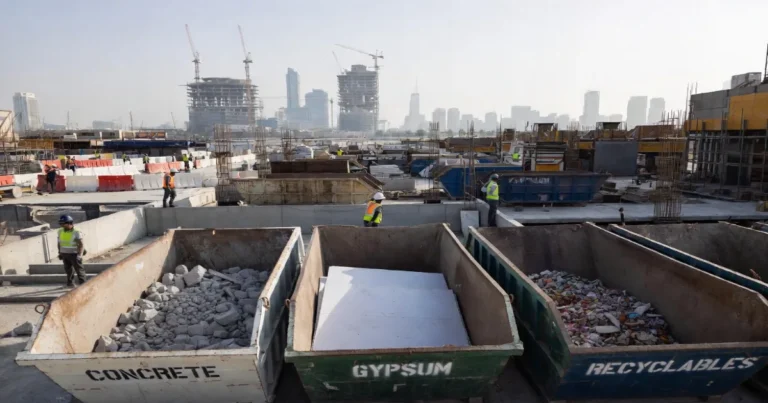
This is straightforward: segregated waste costs less to dispose of than mixed waste. Recyclables have a gate fee of near-zero (sometimes negative, meaning someone pays you for paper, cardboard, metals). Organic waste routed to composting or biogas is cheaper than mixed general waste. Only residual non-recyclable waste should reach WtE — and the WtE gate fee is lower than landfill.
A typical Dubai restaurant or hotel that implements a three-stream system (dry recyclables / organic / residual) typically reduces its waste disposal costs by 20–35% within three months.
📋 Not sure if you’re WTN compliant in 2026? We’ll audit your current waste streams, flag compliance gaps, and provide a cost comparison — free, in 24 hours.
Book Free Compliance Check →The Honest Challenges (Because You Deserve the Full Picture)
Warsan is genuinely impressive, but no infrastructure project this scale is without challenges. Here are the real ones — and what’s being done about them.
Feedstock Quality
Mixed, wet, or contaminated waste reduces combustion efficiency, increases corrosion in boiler tubes, and can push emission levels upward. The plant performs best when it receives consistent, higher-calorific waste. This is why upstream segregation matters — not just for your costs, but for the system’s overall performance.
The Recycling Balance
WtE should always be the last resort before landfill — not a replacement for recycling. There is a genuine risk that cheap WtE gate fees reduce the economic incentive to recycle. Dubai Municipality addresses this through mandatory recycling rate floors, pre-sort requirements for large waste generators, and feed caps on biogenic and recyclable material entering the plant. Recycling remains the priority; WtE handles what genuinely cannot be economically recycled.
Public Perception
Warsan publishes real-time emissions data on public dashboards. Quarterly open days give residents access to operators, live emissions screens, and ash samples. School programs trace waste from home to plant. This transparency is working: public trust in the facility has grown consistently since commissioning. The old myth that WtE means “unfiltered smoke” simply doesn’t survive contact with the actual data.
Long-term Waste Volume Risk
As Dubai’s circular economy matures and waste-reduction-at-source programs succeed, less residual waste will exist to feed the plant. This is actually a good problem — but it means WtE contracts need adaptive throughput clauses, and the system needs to evolve toward handling increasingly pre-sorted, high-efficiency feedstock rather than raw mixed waste.
Dubai’s Strategic Vision: Where WtE Fits in the Bigger Picture
Warsan isn’t a standalone project. It sits at the intersection of four major policy frameworks:
- Dubai Clean Energy Strategy 2050 — WtE as a firm-baseload complement to solar PV and CSP
- UAE Energy Strategy 2050 — diversifying away from gas dependency
- UAE Circular Economy Policy — material recovery, zero waste to landfill
- Dubai Master Waste Management Plan — integrated collection, recycling, energy recovery, safe disposal with SMART KPIs
Common purpose across utilities, city services, and private operators has historically produced better implementation outcomes. The Warsan PPP model — with aligned KPIs across Dubai Municipality, DEWA, and Warsan WMC — is now being referenced as a template for WtE projects across Saudi Arabia, Qatar, and Oman.
Frequently Asked Questions
How much waste does the Warsan plant process in 2026?
As of February 2026, the Warsan Waste Management Centre processes up to 6,000 tonnes of municipal waste per day across five combustion lines — roughly half of Dubai’s total daily municipal solid waste generation. Annual throughput is approximately 2 million tonnes.
Does the Warsan plant really power 135,000 homes?
Yes. Gross output is 200–220 MW. After using approximately 55 MW to power the plant itself and the adjacent Al Awir wastewater treatment facility, the remaining 145–165 MW is exported to DEWA’s grid — enough for approximately 135,000 Dubai homes based on average residential consumption.
How are emissions controlled at the Warsan plant?
The plant uses a multi-stage flue-gas treatment system: dry/semi-dry acid gas scrubbing, activated carbon injection (for dioxins and heavy metals), baghouse fabric filters (for particulates), and selective catalytic reduction — SCR — (for NOx). All parameters are monitored continuously (CEMS) and must meet EU Industrial Emissions Directive 2010/75/EU limits. Results are publicly available on the Dubai Municipality emissions dashboard.
When is Phase 2 launching and what will it add?
Phase 2 was confirmed by the Dubai Supreme Council of Energy on 15 February 2026 and is scheduled to launch later in 2026. It will increase daily waste processing capacity, boost net electricity output to the DEWA grid, and further advance Dubai’s zero-landfill-by-2041 target. The estimated Phase 2 investment is approximately USD 500 million.
Does WtE reduce recycling? Does Dubai prioritise burning over recycling?
No — and this is important. Dubai’s waste hierarchy places reduction and reuse first, recycling second, energy recovery third, and landfill last. The Warsan plant is designed for residual, non-recyclable waste. Dubai Municipality enforces mandatory recycling rate floors and pre-sort requirements for large waste generators. Recyclables (paper, glass, metals, plastics) are separated upstream; WtE handles what genuinely cannot be economically recycled.
How does WtE affect my business’s waste disposal costs?
As landfill gate fees rise and WtE becomes the dominant disposal route for residual waste, businesses that properly segregate their waste save money. Recyclables attract near-zero (or negative) gate fees. Organic waste routed to composting or biogas is cheaper than mixed general waste. Only true residual waste should reach WtE, which is priced below landfill. Companies implementing a three-stream system typically reduce disposal costs by 20–35% within three months.
Who built and operates the Warsan WtE plant?
The project was developed by Dubai Municipality under a 35-year public-private partnership. The EPC contract was led by Hitachi Zosen Inova (technology and combustion systems) and BESIX (civil and structural works), with a consortium of commercial banks and export credit agencies providing project finance. Warsan Waste Management Company operates the facility under the long-term PPP agreement.
What is Dubai’s 2041 zero-landfill goal?
Dubai Municipality has committed to eliminating all municipal solid waste going to landfill by 2041. This will be achieved through a combination of waste reduction at source, expanded recycling and composting infrastructure, growth of the WtE facility (including Phase 2 and future phases), and stricter compliance enforcement. The current 62% landfill diversion rate shows strong progress toward this target.
Is Your Business Waste-Ready for 2026?
Whether you operate a restaurant, hotel, construction site, factory, or office tower — we make sure your waste is properly segregated, collected on time with digital tracking, and 100% compliant with 2026 Dubai Municipality rules (WTN, AI inspections, landfill fees).
Get Your Free 2026 Waste Audit →